- Beyond Productivity
- Posts
- How to be effective and calm (Cultivating Acceptance)
How to be effective and calm (Cultivating Acceptance)

Dear readers,
Next week is Valentine’s Day. But don’t worry, there will be no relationship advice from me. There is, however, an interesting pattern worth noting: by Valentine’s Day, around 80% of New Year’s resolutions have already fallen apart. For most people, the reason is not a lack of knowledge or motivation. Rather, they lack systems, support, and accountability. That’s why I want to share two quick announcements.
First, I have three open seats in my Becoming Ultraproductive 1:1 Coaching Program in March. Over three months, I work with executives, entrepreneurs, and leaders by personally providing the support, systems, and accountability they need to double their productivity and master stress. The program is limited to 10 clients at a time and includes a guaranteed 100% increase in productivity. Seats will be filled on a first-come, first-served basis, so if you’re interested, learn more and get in touch here today.
Second, I will be hosting a free 60-minute live masterclass on how to set and crush your biggest goals in 2026. It takes place on February 19. You’ll learn how to set ambitious goals, stay focused on what truly matters, and turn intention into consistent progress this year. You’ll also get actionable, science-based systems you can apply right away, followed by a live Q&A to address your specific challenges. Spots are limited, so sign up here today to secure yours.
On to today’s post!
“What would it be like if I could accept life, accept this moment, exactly as it is?” — Tara Brach
Why it works
Tara Brach (pictured) is a clinical psychologist, meditation teacher, and author who blends mindfulness with modern psychology. In her eponymous New York Times bestseller, she defines Radical Acceptance as the willingness to fully acknowledge what is happening in the present moment, including your thoughts, feelings, and bodily sensations. Rather than trying to suppress, fix, or escape experience, Radical Acceptance invites us to meet reality exactly as it is, not as we wish it to be.
For a long time, this idea really turned me off. I misunderstood Radical Acceptance as passive, powerless, and incompatible with ambition. That changed when I encountered a simple yet powerful equation that is central to the book: suffering equals pain multiplied by resistance. Suffering does not arise from pain itself, but from our mental struggle with it. Pain (think fear, rejection, or frustration) is inevitable. Suffering, however, is optional. It arises from resistance, judgment, and the belief that this should not be happening. This creates a multiplication effect: the more you resist, the more you suffer, even when the pain itself is small. A minor annoyance can turn into a huge ordeal. But if resistance drops to zero, suffering drops to zero too, even if pain remains.
This same insight is echoed in modern psychology, particularly in Acceptance and Commitment Therapy, which shows that lowering resistance to inner experience is often the fastest way to reduce suffering and regain effective action. Crucially, acceptance does not make you passive. It puts you in a better position to deal with what is actually happening. It does not block change, but creates the space for it. Acceptance is not a vague mindset, but a trainable skill. In daily life, resistance shows up most often in three domains: our emotions, thoughts, and urges. Here’s how to work with each of them.
How to do it
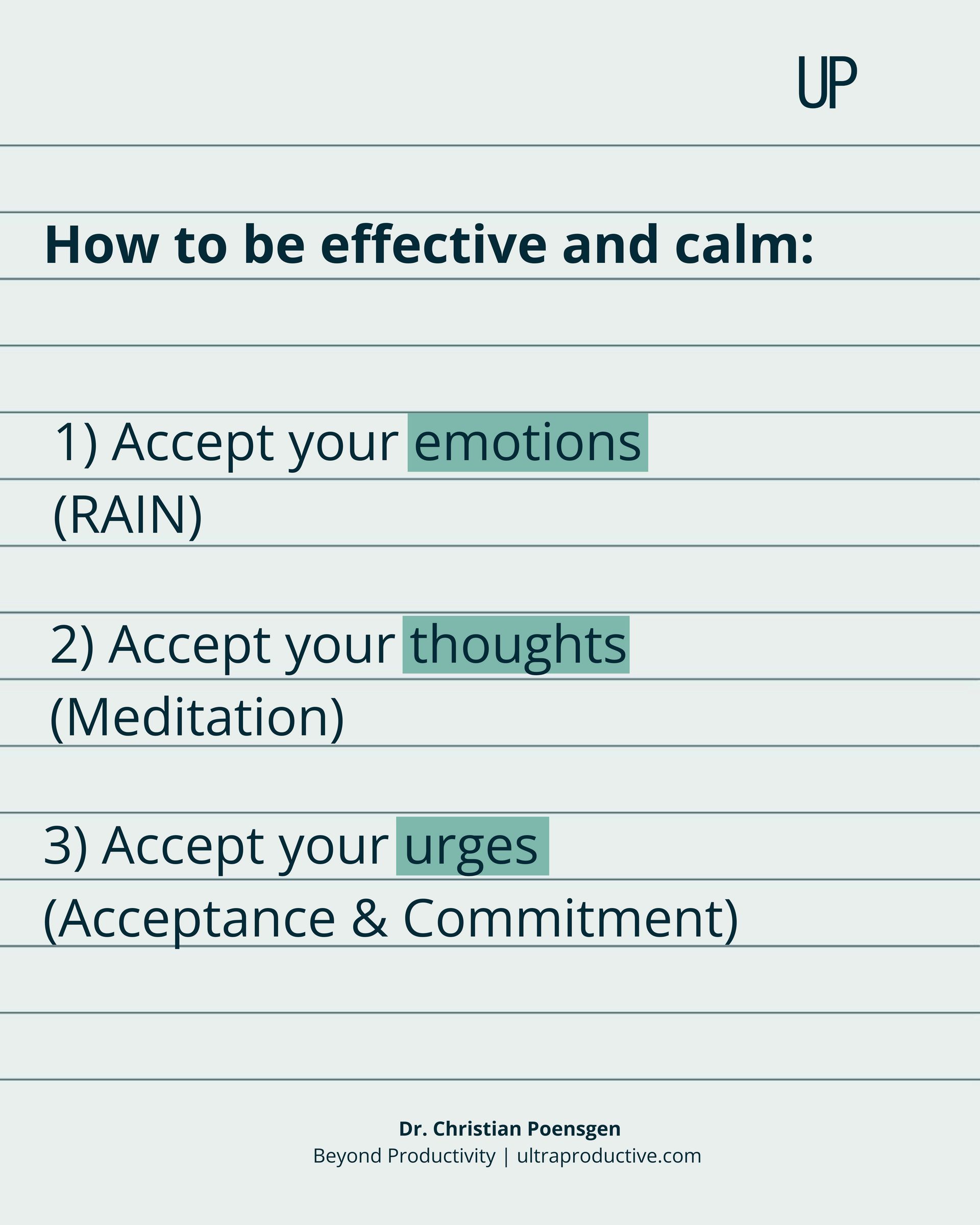
1) Accept your emotions (RAIN)
Research shows that suppressing negative emotions doesn’t make them disappear, but actually makes them stronger. Wanting unpleasant emotions to go away is human. Trying to fight them, however, tends to amplify them. Tara Brach’s most widely used method for working with emotions is RAIN, a simple practice designed to lower resistance and interrupt automatic emotional reactions.
Here’s how to practice RAIN in the moment:
Recognize what is happening.
Allow the experience to be there, just as it is.
Investigate with interest and care.
Nurture with self-compassion.
RAIN is not about indulging emotions or getting stuck in them. It is about meeting them so they can move through you rather than get stuck inside you. If you want to dive deeper into RAIN, start here.
2) Accept your thoughts (Meditation)
Meditation applies the same core logic to thoughts that RAIN applies to emotions. Thoughts are not the problem. Resisting them is. Meditation trains you to let thoughts arise and pass without identifying with them, elaborating them, or trying to get rid of them.
Here’s a simple meditation practice:
Sit quietly and focus on your breath.
Count each exhalation up to ten.
When your attention drifts (as it always will), gently return to the breath.
Begin counting exhalations up to ten again.
Practicing this regularly for five to ten minutes a day (ideally in the morning) builds the capacity to see thoughts as mental events rather than facts you must act on. Over time, this allows you to focus when you want to and let go when you should. If you want to dive deeper into meditation, this resource is the best I’ve come across.
3) Accept your urges (Acceptance & Commitment)
Most people believe they must fight unwanted urges in order to change them. When those urges inevitably persist, this struggle is often interpreted as a personal failure. Yet research on self-compassion suggests the opposite. Harsh self-judgment often ends up strengthening the very patterns we want to overcome.
Here’s what to do instead:
Notice and allow the urge as a current pattern, without labeling it as good or bad or turning it into a personal failure.
Reconnect with what matters to you in this situation. What kind of person do you want to be here?
Choose the smallest next action that aligns with that identity, without forcing immediate change.
Sustainable change often begins with acknowledging current experience and behavior without adding shame, rather than attacking it. Acceptance and Commitment Therapy captures this insight simply: focus on what you can influence and accept the rest. If you want to dive deeper, read this.
Acceptance does not mean approving of everything you do. It means seeing clearly what is happening, so you can choose actions that align with what truly matters to you.
Take a simple example most of us know all too well: a flight delay. The pain is unavoidable. The plane is late. That is reality. Resistance shows up when you start complaining, getting angry, or replaying thoughts like “this shouldn’t be happening.” Emotionally, you fuel frustration. Mentally, you keep rehearsing the same story. Behaviorally, you snap at people or stew in resentment. The result is suffering. Not because of the delay itself, but because resistance multiplies the pain and can easily ruin your entire day. Acceptance looks different. You notice the frustration without fighting it. You allow thoughts like “this is annoying” without turning it into a catastrophe. You accept what you cannot change and choose a constructive action instead—reading, working, or simply resting. The pain remains. But when you lower resistance, the suffering drops, too.
Here’s another example that, as a father of a two-year-old and a nine-month-old, I’m experiencing quite a lot these days. You are trying to put your child to sleep. An hour passes. The crying continues. You are exhausted. That is the pain. Resistance shows up when emotions like frustration escalate, or thoughts like “this can’t be happening” take over. Emotionally, frustration escalates. Mentally, you feel trapped. Behaviorally, you tense up or become short-tempered. Yet resistance does not make the situation better. It quietly makes it worse. Acceptance starts when you allow your own exhaustion to be there. You stop fighting the moment. You respond with presence instead of pressure. You remind yourself that your child is not giving you a hard time, but is having a hard time. And only after the situation is resolved do you act where action truly helps, for example, by looking at their meal or nap timing.
In both examples, nothing changes on the outside at first. What changes is your relationship to what is happening. Acceptance first. Improvement follows. That alone reduces suffering and restores choice.
Here’s my challenge for you:
Pick one of the three methods and give it a try today:
1) RAIN for emotions
2) Meditation for thoughts
3) Acceptance & Commitment for urges
Do not aim for perfection. Aim for a little less resistance.
That alone can make you calmer and, paradoxically, far more effective.
Until next month,
Christian
PS: Want to grow and monetize your LinkedIn (fast)?
There are 800 million users on LinkedIn, and 99% of them aren’t creators.
Translation? There has never been a better time to grow an audience on LinkedIn.
Unlike most other LinkedIn growth coaches, my co-author Eric Partaker and I walked the talk:
We’ve built a 1+ million audience across LinkedIn (1,000,000+ followers) and our newsletters (200,000+ subscribers) in just 12 months
We’ve created a 7-figure business from our LinkedIn thought leadership through services (e.g. coaching) and products (e.g. courses)
We’ve been ranked #1 LinkedIn creators by Favikon and got a book deal with Portfolio Penguin for our first book
Our #1 goal for this coaching program is to make it the highest ROI investment of your life. Learn more and book a free discovery call here so that we can get in touch.
2 more ways I can help you
Want a free PDF of my top infographics? Get it here.
Interested in sponsorships for my newsletter or LinkedIn? Get in touch here.