- Beyond Productivity
- Posts
- How to solve hard problems (The 3I Method)
How to solve hard problems (The 3I Method)

Dear readers,
Before we get to today’s post, I have exciting news.
On March 19, 2026, I will be hosting a free 60-minute live masterclass on how to build better habits and break bad ones.
I’ll share actionable, science-based systems you can apply immediately, followed by a live Q&A to address your specific challenges.
Spots are limited. Sign up here today to secure yours. Looking forward to meeting you live!
On to today’s post.
“The desire to do something because you find it deeply satisfying and personally challenging inspires the highest levels of creativity, whether it’s in the arts, sciences, or business.” — Teresa Amabile
Why it works
Teresa Amabile (pictured) is an American organizational psychologist best known for her research on motivation, performance, and creativity in the workplace. Having spent most of her academic career as a professor at Harvard Business School, she is one of the most influential scholars on workplace creativity. Her definition of it became the gold standard in organizational psychology: “The production of ideas or solutions that are both novel and appropriate to the task.”
Creativity has an image problem. Most people associate it with the fine arts: painting, music, and writing. But creativity is the invisible force behind virtually all the services and products we consume every day. As Steve Jobs famously said, “Everything around you that you call life was made up by people that were no smarter than you.” When you read the news, you’re consuming the result of a journalist’s creativity. When you listen to a podcast, that’s the host’s creativity. When you watch a show, that’s the screenwriter’s creativity. When you check social media, that’s the creative output of, yes, creators. And on and on. Anything you buy is the result of entrepreneurial and organizational creativity. According to Naval Ravikant, creativity is one of the most important skills of the 21st century, and one of the few skills unlikely to disappear in the age of AI.
Here’s the good news: your brain works creatively on your most pressing problems around the clock, seven days a week, either consciously or unconsciously, if you let it. To harness that power, it helps to think of creativity as a three-step process: Input, Processing, Output. First comes Inspiration, the deliberate gathering of quality inputs. Next comes Incubation, where ideas are processed and recombined, mostly unconsciously. Finally comes Implementation, the deliberate execution that turns insight into tangible results. Together, these three steps form the 3I Method. Here’s how to boost your creativity to solve hard problems along those steps, and three powerful tips for each one.
How to do it
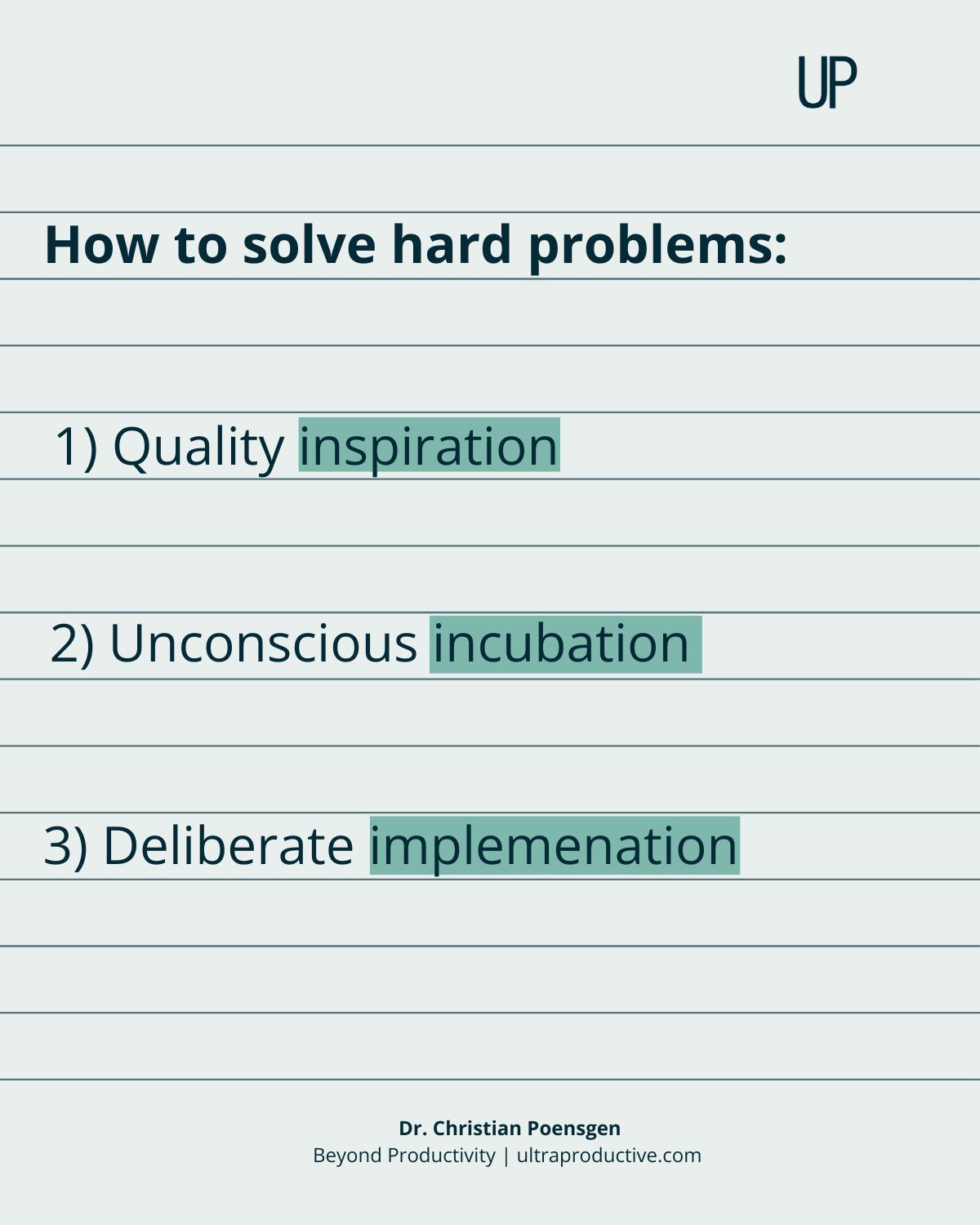
1) Quality inspiration
If you want to produce ideas that are both novel and appropriate, you need to deeply understand the problem and the existing solutions. Creativity does not begin with originality. It begins with immersion.
Tip 1: Keep the garbage out
What do Tim Ferriss, Ryan Holiday, and Andrew Huberman have in common? They’ve all publicly stated that they don’t use social media on their phones. If you waste your time and attention on the highlight reels of people you barely know, you will end up distracted, miserable, and uncreative. Garbage in, garbage out. So remove Instagram, LinkedIn, and the rest from your phone. You can still use them on your computer. I beg you: Try it for just three days. I’ve been doing this for years and never looked back. Like the gentlemen above, I’m a creator myself who posts on social media every day, but I still keep it off my phone.
Tip 2: Learn deliberately
To deeply understand the problem and the existing solutions, read widely in the domain you’re trying to be creative in. Before I wrote my first book, I read hundreds of books in the productivity and personal development space (my three all-time favorites are Deep Work, Antifragile, and Four Thousand Weeks). The more deeply you understand a field, the more intelligently you can break its rules. Have trouble reading? Follow Naval Ravikant’s brilliant advice to read what you love until you love to read. No time for reading? Tips on that are next.
Tip 3: Make the time
Even without social media, your phone will kill your creativity by filling every idle minute with every bad thing happening in the world. As it turns out, most of that happens in the first and last hours of the day. The solution: Intermittent Digital Fasting. Put your phone into its own bedroom (not yours!) one hour before bed; let it “sleep in” for at least one hour after you wake up. You’ll create two input-free hours per day (here’s a deep dive). Apart from reading, you can use that time to journal about the problem, talk to interesting people about it, or let your mind go into incubation mode.
2) Unconscious incubation
Incubation is where your mind processes and recombines ideas, and this mostly happens unconsciously. When your mind is free of external inputs, it starts using what you already know in novel ways. But if you never give your mind some silence, it cannot synthesize.
Tip 1: Walk
The nineteenth-century philosopher Friedrich Nietzsche wrote, “Only thoughts reached by walking have value.” Modern science agrees. In a landmark 2014 Stanford study, researchers found that walking increased creative output by about 60 percent compared to sitting. Fortunately, you don’t need a three-hour hike. Carve out 30 minutes a day without audiovisual input while walking, exercising, or doing chores. Skip the podcast and notice what surfaces in the silence. I never take my phone on walks, runs, or to the gym. Many of my best ideas have emerged there.
Tip 2: Sleep
Reid Hoffman, the co-founder of PayPal and LinkedIn, has described how he gives his brain a problem before sleep and lets it work overnight. You simply write it down on a piece of paper before bed and revisit it in the morning. High-quality sleep (with plenty of deep and REM sleep) supports memory consolidation and associative thinking, making it a creative powerhouse. If you consistently get 7.5+ hours of high-quality sleep (here’s how), your brain will connect dots you didn’t know were related. Keep a notepad close to your bed to write down what comes up first thing in the morning.
Tip 3: Retreat
I’ve got a confession to make. Over 90 percent of my best ideas came to me on weekend silent retreats, which I do a couple of times each year (at this beautiful monastery-turned-meditation center in Bavaria). But you don’t have to go that far. A retreat does not require a monastery. It requires intentional solitude and structured silence. Spend one morning each weekend alone with your thoughts. Go for a longer walk and leave your phone at home. Or sit somewhere quiet with a notebook and a single question. You’ll be shocked at the ideas that will bubble up out of nowhere. Silence is not empty. It is fertile.
3) Deliberate implementation
Finally comes implementation, the disciplined execution that turns insight into tangible results, like concepts, plans, or presentations. If you want the muse to show up and kiss you, you’ve got to be there at your desk, working. Creativity without execution is daydreaming.
Tip 1: Ultrafocus
Creative implementation requires what Cal Newport calls Deep Work (again, that book is a must-read). Our “Ultrafocus” method is a simple way to make this work on a busy schedule. Make it a priority to focus intensely on that task for 60-90 minutes at a time each day. Use our 30-3-11 rule to time it when your energy and motivation are highest: ~30 minutes after waking, ~3 hours after waking, or ~11 hours after waking. For 75% of us, mornings are best. If you want to learn more about the Ultrafocus method, read this article.
Tip 2: Whiteboard Effect
In Deep Work, Cal Newport also describes a phenomenon called the Whiteboard Effect. Newport defines it as a form of collaborative deep work in which working with others pushes you deeper than working alone. It is not simply brainstorming; it refers specifically to deep, concentrated collaboration. When two or three people focus intensely on a hard problem in the same space, creativity compounds. The presence of another person waiting for your next insight increases your depth of focus, because you feel a subtle social pressure to contribute something meaningful. And because you must articulate your thinking clearly in front of others, vague ideas get exposed, refined, and often transformed into breakthroughs.
Tip 3: Show your work
There is nothing more motivating and terrifying than sharing your work publicly. We are social animals, so accountability and exposure will bring out your best thinking. When I started this newsletter almost five years ago, it felt frightening. Yet, it quickly became the foundation of my business. When I started posting on LinkedIn regularly 2.5 years ago, it was intimidating. A couple of months later, it helped me secure a major book deal with nine top publishers around the globe, including Portfolio Penguin (who publish authors like Cal Newport, Ryan Holiday, and Oprah Winfrey) in the United States. If you want to learn more about how you can leverage your creativity to grow your business, book a free discovery call with me here.
Creativity is not magic.
It is quality inspiration, unconscious incubation, and deliberate implementation.
If you have a brain, you’re as capable of it as anyone.
So here’s my question for you:
What is the one hard problem in your life right now that deserves your best creative thinking?
And here’s my challenge for you:
Get creative and use the 3I Method to solve that problem this week:
1) Put your phone away one hour before and after bed.
2) Spend 30 minutes a day without audiovisual input to let ideas surface.
3) Focus deeply for 60-90 minutes to turn these ideas into tangible results.
Your brain is far more creative than you realize.
Until next month,
Christian
PS:
Are you struggling to focus on the important work being busy with urgent stuff? Are you feeling tired throughout the day despite sleeping for 7 or 8 hours at night? Are you having trouble dealing with high stress at work and "switching off" at home?
If that sounds familiar, my Becoming Ultraproductive 1:1 Coaching Program is for you. In it, I personally provide the support, systems and accountability that executives, entrepreneurs and leaders need to double their productivity and master stress in just 3 months.
Since 2023, I’ve coached 85+ executives, entrepreneurs and leaders on Becoming Ultraproductive. The program includes:
1:1 personal coaching with me over 3 months (6 sessions customized to your needs)
Tailored systems to optimize your focus, energy, motivation, sleep, stress & more
A guaranteed 100% productivity increase (not kidding)
Interested? Learn more and book your free discovery call here while you can. I only take on 10 clients at a time and seats are booking fast.
Want to grow and monetize your LinkedIn (fast)?
There are 800 million users on LinkedIn, and 99% of them aren’t creators.
Translation? There has never been a better time to grow an audience on LinkedIn.
Unlike most other LinkedIn growth coaches, my co-author Eric Partaker and I walked the talk:
We’ve built a 1+ million audience across LinkedIn (1,000,000+ followers) and our newsletters (200,000+ subscribers) in just 12 months
We’ve created a 7-figure business from our LinkedIn thought leadership through services (e.g. coaching) and products (e.g. courses)
We’ve been ranked #1 LinkedIn creators by Favikon and got a book deal with Portfolio Penguin for our first book
Our #1 goal for this coaching program is to make it the highest ROI investment of your life. Learn more and book a free discovery call here so that we can get in touch.
2 more ways I can help you
Want a free PDF of my top infographics? Get it here.
Interested in sponsorships for my newsletter or LinkedIn? Get in touch here.